Through Our Lens: Queer Womxn of Color's Experiences of Healing and Liberation
Healing & Liberation Exhibit

What is Photovoice?
Photovoice is a creative research method that uses photography, storytelling, and dialogue to explore and highlight the experiences of marginalized individuals for social justice and transformation (Latz, 2017; Wang, 1999; Wang & Burris, 1997). A photovoice exhibit is designed to share the experiences, concerns, issues, and needs of marginalized communities with community members and key stakeholders for advocacy and systemic change.
Due to the multifaceted, intersubjective, and intersecting experiences of Queer Womxn of Color (QWoC), this project used photovoice as the research methodology and was informed by intersectionality theory (Crenshaw, 1989, 1991; Hunting, 2014). The purpose of this photovoice project was to explore QWoC healing experiences inside and outside of counseling.
Through Our Lens Exhibit
Through Our Lens: Queer Womxn of Color's Experiences of Healing and Liberation is a photovoice exhibit that stems from a larger photovoice project designed to explore and honor the healing experiences of QWoC inside and outside counseling. Through Our Lens is an exhibit that centers the work of nine Queer Womxn of Color who brilliantly captured their healing experiences through photographs and storytelling as an act of resistance and liberation.
We use the term co-researchers instead of participants to underscore our commitment to liberatory practices that intentionally shift power relations throughout the research process to acknowledge that research participants are collaborators and co-creators of knowledge.

Who We Are
We are an innovative and collaborative research collective, dedicated to pushing the bounds of traditional research methodologies by advancing liberatory and anti-oppressive research in the counseling field. We started as a university research lab, formerly known as the Transformative Praxis Research Lab. To honor our growth as a collective of folks dedicated to decolonial and anti-oppressive work we intentionally separated from an institution that continues to uphold oppressive and colonial structures. We evolved and transformed into a liberatory research collective, welcoming scholars, educators, counselors, and community members from across the country. We aim to co-create a space where anyone interested in research, particularly marginalized communities can develop the skills needed to engage in transformative and decolonial research.
About the Curators
The Curators are a group of eight counselor educators, practitioners, and students who were part of the larger photovoice study. Through their collective efforts, they have curated an exhibit to offer a glimpse into the study through the lens of the co-researchers with the goal of maximizing the accessibility of liberatory research.
Exhibit
We invite you to explore the exhibit below. Please use the arrows to view the new images and discover more content!
Alina
"An Anomaly"
A feeling inside that is foreign, different, unidentifiable, uncomfortable.
But it is me and mine.

Image Description: A sunset with a contrail and an unknown trail in the sky.
Anai
"CSULB"
I love walking at CSULB with my boyfriend.

Image Description: Walkway lined with purple flowers and trees at night.
Esperanza
"Cleanse And Rest"
This photograph encapsulates the calmest moment of my life. The water was cool, the sun was hot, and the lavender aromatics filled the space. Red Moon in Venus played softly as the birds chirped and butterflies floated by.

Image Description: A person sitting in an outdoor tub with the sun peeking through the trees as they soak and hold a glass of white wine.
Jet
"Betsy, The Goat"
My cousin keeps goats now and again, and I'm really fond of them. The goats are good company and will occasionally butt into your leg for attention; they're kind of like cats in that way. I often go to my cousin's house when I need a pick-me-up or just somewhere I can relax and not be home for awhile. The animals are mellow and I think that rubs off on me.

Image Description: A headshot of a mature female goat (a doe) with black and white splotches on her face and neck. She has floppy ears and a relaxed expression on her face. A hand extends into the frame and pets her neck. I like to think we're friends.
Jingshui
"A Child's Eyes."
Some of the most healing moments in my life have been while playing with kids. They tell me, "Look, look! Isn't the sun so pretty going through these tiles? You can put it over your eyes and make the trees orange!" Reconnecting with hidden gems of wonder again and again is a blessing - one that I've been granted by the generosity of little ones sharing their worlds with me.
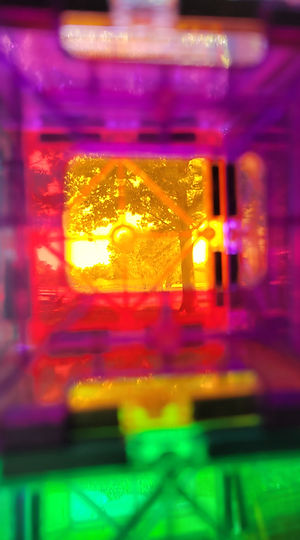
Image Description: Seeing a tree through a kaleidoscope
Khadijah Violet
"Indulge, Allow, Experience"
There are many things I wanted to have, do, and experience as a child that were unattainable to me for various reasons. Some things my family couldn't afford, some things I would be judged for indulging in, and others simply weren't in my grasp. As I've gotten older, I've made it a part of my healing journey to indulge in the things that would have made me happy back then. I allow myself to do things no matter what judgments may come about, or at least I try to. I make the effort to experience happiness consistently, or as consistently as possible while still allowing room for other emotions.

Image Description: A shelf with stuffed animals, trophies, medicine, toys, and books on it.
Kiran
"Cacao Ceremony."
Engaging in ancestral healing practices with other BIPOC folks is incredibly healing to the body, mind, and spirit. I was thankful to partake in this ceremony from indigenous folks.

Image Description: A clay cup of cacao with a handwritten note off to the right-hand side that reads, "Only from the heart can you touch the sky."
Mykie
"Built Tough."
This is my brother's old car. It's an expensive car. A car he promised to fix and get running again. But it's been years, and he's kept it in the backyard - and it's completely just left in the hands of nature with no real protection. During my journey, I felt that way. For a long time, I didn't feel I could talk to people or be open about what I was feeling inside - regarding the people I loved and my gender. I was built to be strong, and everyone knew that about me. I was expected to be successful, and so I kind of just let myself take that baggage on from myself.

Image Description: A rundown black suv caked in dirt that has been leaft to weather the elements for a long time.
Noor
"Yeh Hai Bombay Meri Jaan"
English Translation of the title - "This is Bombay, my dear" is the title of a famous Hindi song released in 1956. Bombay, a big metropolitan city on the west coast of India, is a place I call home. It is called the City of Dreams, and rightfully so. This city made me. This city broke me. This city taught me how to love, how to laugh, how to cry, how to dance, how to be queer, and most importantly, how to be my most authentic self. Everything I am today, I owe it to Bombay. I always carry a piece of this city in my heart wherever I go, and that heals me in indescribable ways.

Image Description: A photo of a front of a major railroad station in Mumbai, in the Italian Gothic style. with buses, cars, motorbikes and pedestrians in the foreground.
About The Co-Researchers
Meet the talented visionaries behind the lens. These creative pioneers have shared their stories through captivating photographs and compelling narratives, shedding light on the beauty and resilience of Queer Womxn of Color.
Alina (she/her) is a 23-year-old pansexual Latina. To Alina, being a queer womxn of color means that she has no limits to who she is or chooses to be; only the world puts limits on queer womxn of color.
Anai (she/her) is a 25-year-old bisexual Mexican woman. To Anai, being a queer womxn of color means unity. However, she feels that there is much compassion towards queer womxn. She thinks there are still so many issues with understanding each other's struggles.
Esperanza (she/her/they/them) is a 25-year-old fat, pansexual, polyamorous, non-binary Latinx femme. To them, being a queer womxn of color means everything. It is who they are and connects them to the divinity in them and the natural world around them.
Jet (she/hers) is a 25-year-old disabled, polysexual, cis Hispanic American woman. To Jet, her identity as a queer womxn of color means that she has accepted to love herself for who she is and not feel pressure to be someone she is not.
Jingshui (they/them) is a 25-year-old pansexual, gray ace, non-binary Chinese person. They identify as non-binary but don't correct people who assume they are a woman if they feel unsafe.
Khadijah Violet (they/she) is a 24-year-old disabled non-binary, bisexual, Black, and Asian person. As they reflected on what their identity as a queer womxn of color means to them, they stated: “I am change, I am hope, I am what could be. I have the experiences of a Black woman and will always have them, but that does not strictly make me a Black woman. I do not fit within the confines of traditional binary gender. I am the in as well as the out. The old and the new.”
Kiran (any pronouns) is a 29-year-old queer and genderqueer Desi person. Their identity as a queer womxn of color means a lot to them as it informs many of the ways they connect with others, themselves, and their ancestors.
Mykie (she/they) is a 33-year-old queer Latina. To them, being a queer womxn of color speaks to how they present themselves and how others view them and tone roles of society.
Noor (she/her/hers) is a 22-year-old pansexual South Indian woman. As she explored what her identity as a queer womxn of color means to her, she stated, “Being a queer womxn of color makes me feel powerful because I am aware that by simply existing in my true and authentic form, I am resisting white supremacy. Besides personal agency and perceived power, my identity as a queer womxn of color brings me so much joy. I recognize the uniqueness and beauty in the identities that I possess, and I love practicing my cultural traditions while keeping my identities at the forefront of my mind to cultivate resiliency, happiness, love, and peace.”
